
Trademark
Don’t waste time and money on your trademark registration. Leaving it to specialists reduces the risk of your application being refused.
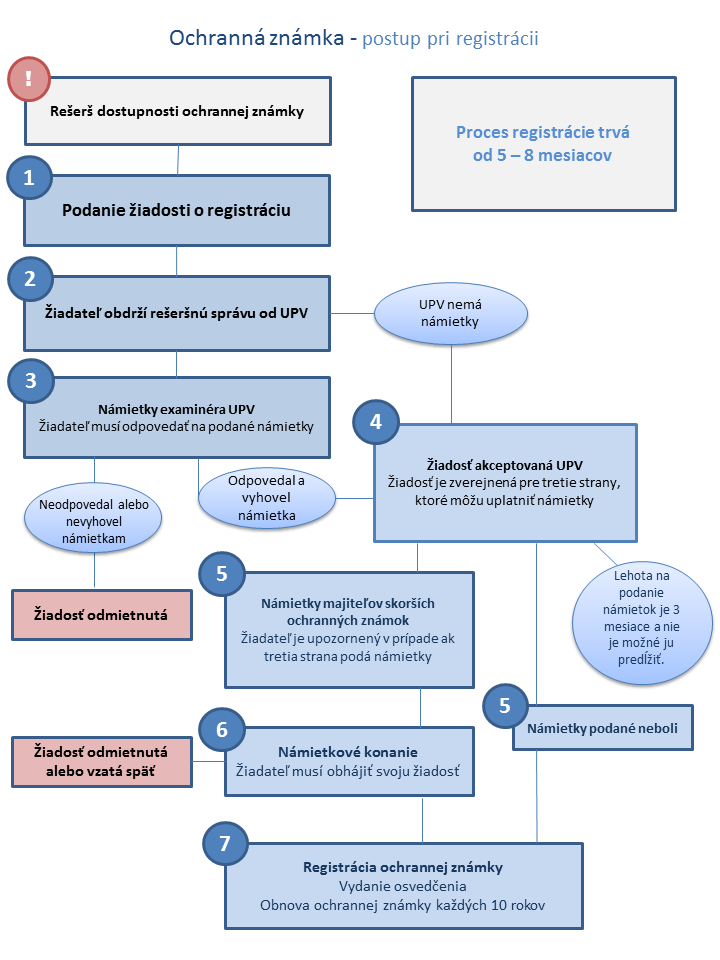
Trademark registration in three steps
Infographic – registration procedure:

Key questions!
Useful links:
FAQ – frequently asked questions
Why choose us?
Working with us pays off!
We can register your trademark quickly and professionally. There is no need to worry about obstacles or delays, because our priority is you – a satisfied client who values our services today and in the future.
Services
Our most popular services include:
- trademark registration
- responses to provisional refusals
- trademark renewal
- consultations
- patent registration
- provisional patent filings
- structuring royalties as tax-deductible expenses
- drafting licence agreements
- drafting franchise agreements
- registering licence agreements
- registering franchise agreements
- design registration
Besides trademark registration, there are other rights that can protect your products, services and business – mainly patents, copyright and domain names. To protect your ideas, we particularly recommend patent law; for artistic works, videos and software, copyright is usually the best fit. Domain names are also playing an ever greater role in marketing your products and services.
Frequently Asked Questions About Trademarks
A sign that can constitute a trademark is any sign capable of graphic representation, consisting in particular of words (including personal names), letters, numerals, drawings, the shape of goods or their packaging, or any combination [...]
Domain Disputes and Domain Protection
There is currently no specific legislation dealing with domain names, and case law applying the relevant provisions of various laws in this area is also scarce. One of the most problematic issues is the conflict [...]
How to Defend Your Trademark Against Infringement
This type of industrial property right is protected by entry in the trademark register kept by the Industrial Property Office. Without the trademark owner's consent, no one may use in the course of trade: a [...]
Trademarks – FAQ
How long does trademark registration take? From filing the application to entry in the register kept by the Industrial Property Office of the Slovak Republic usually takes around 11 to 15 months, provided no significant [...]
Types of Trademarks
National trademark As the name suggests, this is a trademark that is valid in one specific country. In the Slovak Republic, for example, a national trademark is registered through the Industrial Property Office of the [...]
The Difference Between ® and ™
Both the ® and ™ symbols are associated with trademarks and intellectual property. On the Slovak market, the ® symbol is the one most commonly used.
What to Do with a Trademark and the Rights It Gives You
The owner of a trademark has the exclusive right to use it in connection with the goods or services it covers, and may use the trademark together with the ® symbol. Third parties may not, [...]
The Trademark Registration Process
Problems you may encounter when registering a trademark Look around you and try counting how many well-known and lesser-known brands you can see. In the vast majority of cases, they are not just brands [...]
Made an Invention? Patent It!
“Eureka!” – did you just shout it? Did an idea once fire your imagination and excite you so much that you happily spent long hours, days, months or even years researching it, testing it [...]
Benefits of a Trademark
Intellectual property Have you packed a favourite book for your travels? Do you like to go for a run with your favourite song playing from your smartphone? Do you wear a watch or prefer [...]
What to Expect at the Patent Office
Have you developed a new idea, devoted your time to inventing, and is your invention capable of industrial use? If you can answer “yes” to all three questions and you are the inventor, congratulations [...]
Inventions from Slovakia
Can you imagine life without the light bulb, the fridge, the computer or even the humble wheel? Although most inventions were made abroad, Slovakia too can boast of contributions that have changed the world [...]
Patent Protection and Its Scope
In practice, patent protection gives the owner the exclusive right to exploit the invention, to pledge the patent as security or to transfer it to someone else. No one may use or offer to others [...]
Preliminary and Full Examination, Priority and Proceedings before the Office
Filing an application that meets all the requirements gives the applicant a right of priority. In practice, this means that unless the Office decides to refuse the application, no patent can be granted to [...]
Filing a Patent Application for an Invention
To start proceedings for the grant of a patent, you first need to file a written application with the Office in 2 copies. The person entitled to file is always the one who holds the [...]
How to Obtain a Patent and the Conditions for Grant
In Slovakia, the protection of inventions by patent is administered by the Industrial Property Office of the Slovak Republic (the “Office”), which grants the patent by decision. Only once the Office has made that decision [...]
What Is a Trademark?
The main purpose of a trademark is to identify a particular producer's product and distinguish it from identical or similar competing products. It removes anonymity and shapes the image and reputation of the [...]
Trademark Wording
A trademark may not consist of indications of the kind, quality, quantity, intended purpose, price, geographical origin or time of production of goods or provision of services. If our main brand is Google and we [...]
Word and Figurative Trademarks
A company identifies its products and services either with a word alone or with a logo as well. The name and the graphic logo can be registered separately as two trademarks. A trademark can [...]
How Long a Trademark Lasts
A trademark lasts for 10 years from the date the application is filed. Trademark protection can be renewed indefinitely. A trademark takes effect once it is entered in [...]
Trademark Classes
A trademark registration is limited not only by the number of countries it covers but also by the kinds of goods and services it applies to. Goods and services are divided into 45 categories, [...]
US Trademark
Registering a trademark in the USA works much like registering one in the EU, with one key difference: to register in the USA, you must show that the sign is actually used in commerce [...]
EU Trademark
An EU trademark (formerly known as a Community trademark) is a trademark of the European Union that takes effect in every EU member state, including countries that join later. It is valid only within [...]
Slovak Trademark
A trademark is any sign capable of graphic representation – in particular words (including personal names), letters, numerals, drawings, the shape of goods or their packaging, or any combination of these – provided it [...]
International Trademark
If you want to protect your trademark in more than three countries outside the EU, the quickest and most effective route is an international registration under the Madrid Agreement and its Protocol. With one [...]
Countries of the Nice Agreement
When registering a trademark, you need to choose the countries where it should be valid. In other words, one of the key decisions in protecting a brand or logo is how many countries it [...]
Intellectual Property
Intellectual property protects trade names, creations and your inventions. Intellectual property falls into two main categories: • industrial property: rights that give their holders an exclusive monopoly over technical or aesthetic inventions and distinctive [...]
Patents and Fees: Costs and Types
If you are thinking about expanding abroad or bringing in an outside investor, you have probably considered patenting some of your technology, inventions or know-how. Early on, you will no doubt be asking how [...]
Trade Secrets as an Alternative to a Patent
When doing deals with business partners in the USA, England or Asia, or when taking investment from business angels or venture funds, you need to ask whether to protect your assets at all, when [...]